
STAY TUNED FOR ANOTHER SUMMER CAMP COMING IN 2027!
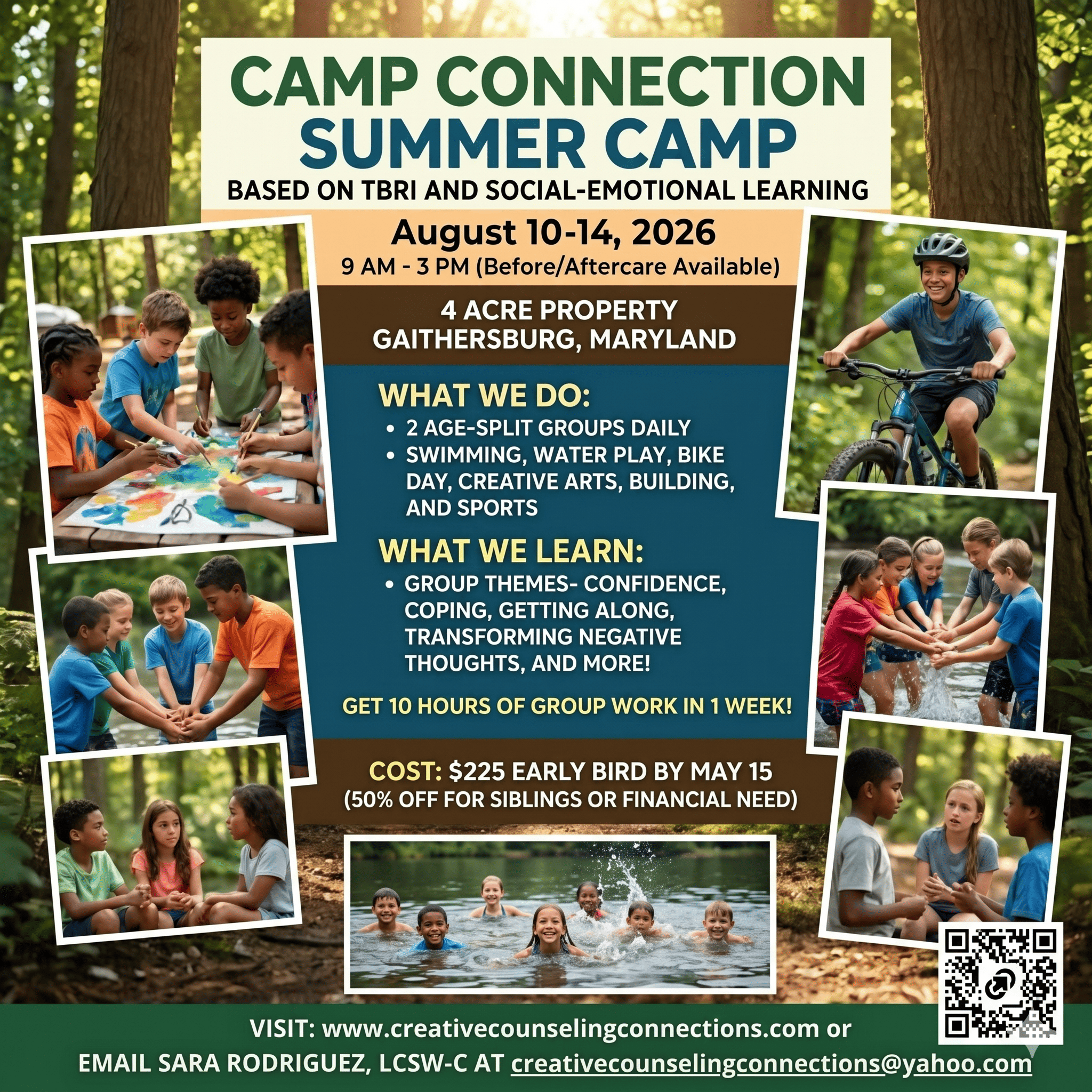
August 10-14, 2026
9-3 PM
Gaithersburg, Maryland
We are excited to announce our very first mental health summer camp for kids 7-13 based on TBRI (Trust Based Relational Intervention) and Making Sense of Your Worth curriculum. Adoptive kids, PANS/PANDAS kiddos are perfect for this camp due to the level of support available!
Registration link for before/after care, 8-4pm: Book Now (click on the summer camp registration and choose any Monday on the calendar to proceed to the payment page; ignore phrase about 30 minute session)
Registration link for regular 9-3 pm camp: Book Now (click on the summer camp registration and choose any Monday on the calendar to proceed to the payment page, ignore phrase about 30 minutes)
Sibling or Financial Need registration link– $150 for the week for a sibling (send requests for financial need to Sara at creativecounselingconnections@yahoo.com; ): Sibling Registration or Financial Need Rate
Carefirst, Blue Cross Blue Shield, Cigna/Evernorth- $100 for the week (assuming deductible met): https://meet.brevo.com/sara-rodriguez/cignacarefirstbcbs-camp-connection-summer-camp-9-3-select-august-10
Having trouble registering on the portal? You may also pay via our Paypal account under email creativecounselingconnections@yahoo.com or our Venmo account: @CreativeCounselingConnections (picture is of a tree branch)
Can’t come this year but interested for next year? Drop your email here: Interest Form
Still have more questions? Email Sara Rodriguez at creativecounselingconnections@yahoo.com with questions.
FAQ’s:
What is the general daily schedule?
Check-in activity 9 AM
Group activities 10 AM
Snack and activity rotations of choice (swimming, sports, building or creative arts) 11 AM
Lunch 12 noon
Group activities 1 PM
Swim/water fun rotations 2 PM
Who will be running the camp?
Depending on the number of children, there will be at least one therapeutic lead (therapist or graduate intern) and at least one student volunteer for each group. If your child needs a one-on-one buddy, please let us know at creativecounselingconnections@yahoo.com so that can be planned in advance.
Can anyone attend?
Absolutely! Every child can benefit from increasing skills in communication, handling feelings, working together, healthy thinking and conflict management!
Does my child need to be an avid swimmer to attend?
No, but please send children who need swim support with a life vest each day. The pool is 5 feet in depth. For safety reasons, children will only be permitted to swim when the pool is monitored.
What can our kids/teens expect during group time?
Groups will be split up by age and will occur twice daily. The activities will include a wide range of interests so that everyone can both enjoy their typical activity of choice and also be challenged to try new activities (flexibility!) that perhaps they wouldn’t normally choose.
Kids will be paired with either 1) a peer buddy or 2) an older mentor buddy during group games in order to practice social interactions
What is TBRI (Trust-Based Relational Intervention), the model the camp is based upon?
Trust-Based Relational Intervention (TBRI) is a holistic, evidence-based caregiving framework designed to support children. Developed by the Karyn Purvis Institute of Child Development, it is grounded in attachment theory and neurobiology, a model of healing through connection. The intervention is structured around three primary pillars: Empowering Principles to address physical and environmental needs, Connecting Principles to build trust and felt safety, and Correcting Principles to teach self-regulation and prosocial behavior in a non-punitive manner. At Camp Connection, we take principles from each concept and apply to the camp model.
For Empowering principles, each camper will have sensory and physical needs met at least every 2 hours- likely more- as sensory experiences will occur frequently throughout the day. There will be a structure and routine, support during transitions.
For Connection Principles, campers will practice connection to their peers or to their support “buddy” (either a peer or older mentor buddy) through playful engagement and learning regulatory strategies together (for instance, engaging in exciting activity, then practicing a calming activity afterwards).
For Correcting Strategies, support staff’s primary goal is to connect before correcting. Campers will be encouraged to be assertive with expressing the need behind their behaviors.
We are happy to share resources with parents to support application at home.
Can you tell me more about what topics will be covered?
Group games and follow up activities will support the concepts discussed within group. For instance, if group begins with the topic of “riding the waves” of emotions, we will paint a wave on a canvas. If group discussion is focused on “working together,” the group game may include a water relay game between two peers or roleplay in conflict resolution.
Topics (adjusted for age/development): understanding and riding the waves of emotions, coping strategies, conflict resolution and healthy relationships, assertiveness, flexibility. For the older group, we will delve into recovery from bullying, red flags in relationships, etc.
CREATIVE COUNSELING CONNECTIONS
Helping individuals and families heal, connect, and grow